

Facts v Fallacy
Thanks for your interested in the three‑part MEA Voice “Facts v Fallacy” series. Here you’ll find links to the stories from the magazine, as well as related source information and links for those wanting a more in-depth look at the issues.
Part I: School Performance
MEA Labor Economist Tanner Delpier tells stories with data. The tale he tells of public education in Michigan runs counter to the message heard far too often in sound bites on the news. We continually hear that public schools are “failing,” despite “record” state funding, because educators lack “accountability.”
“None of that is true,” Delpier says. Read the full story here from the December 2025-January 2026 MEA Voice.
- Member Voice – Amy Urbanowski-Nowak: Listen to educators for a change
- In-Depth – “Michigan’s NAEP Performance” Policy Brief by Dr. Tanner Delpier
- Sources from the MEA Voice articles and other information:
- From the National Assessment of Education Progress (NAEP):
- From the Michigan League for Public Policy (MLPP):
Part II: School Funding
When it comes to analyzing improvement in Michigan school funding, a lot depends on when you start looking. Why start in 2012, for example? The answer is simple: when compared to bottomed-out K-12 spending in that year, gains since then look unprecedented. But further pulling back the curtain from 2012 to 2002 reveals the true trendline.
“There was a massive decline from 2002 to 2014, and earlier funding levels have not yet been restored,” says MEA Labor Economist Tanner Delpier. “While the state is no longer at the lowest funding level in history, (school) funding remains 32% below that early 2000s peak — a gap amounting to about $10.4 billion. The truth is that funding has dropped sharply since Proposal A in 1994.”
Read the full story here from the February-March 2026 MEA Voice.
- Updates: See fresh versions of the charts from the magazine with data for the latest year:
- Real PK-12 Education Revenue (2012-2025)
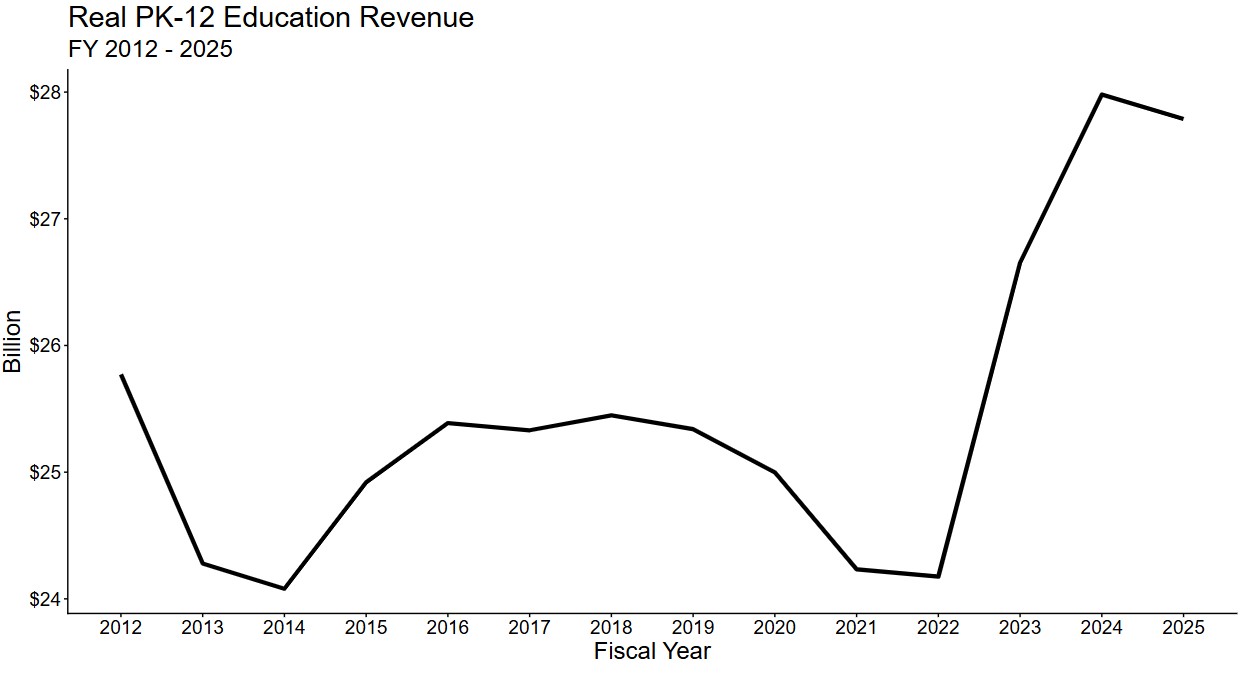
- Real PK-12 Education Revenue (1995-2025)
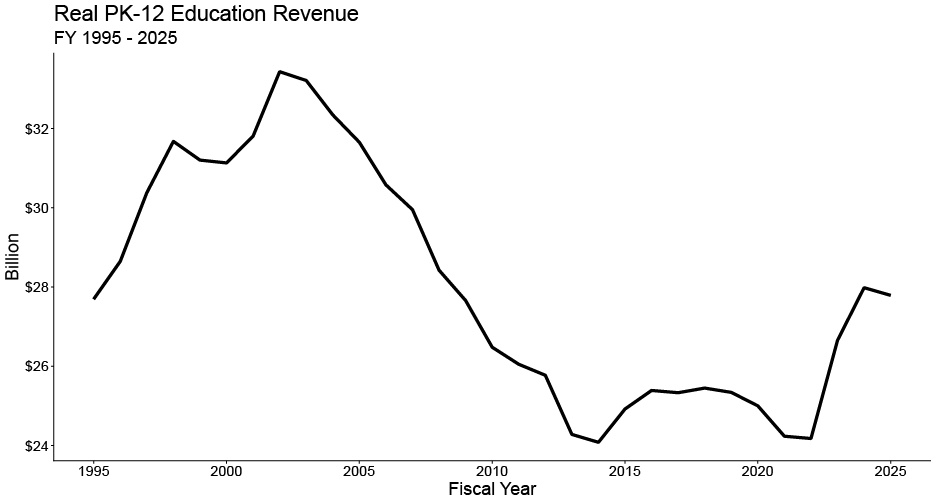
- Real PK-12 Education Revenue (2012-2025)
- Sources from the MEA Voice articles and other information:
- Financial Information Database (FID) for FY 2004 – 2025 and Form B for FY 1995 – 2003
- From MSU’s Education Policy Innovation Collaborative (EPIC): Funding Michigan’s Future
- From School Finance Research Collaborative (SFRC): School Funding Adequacy Studies
- Related: Higher ed member’s research shows vouchers harm kids
Part III: School Policy
MEA member Danielle Cover has seen the difference it makes for students when state leaders listen to educators and deliver resources that schools need, rather than issuing unfunded mandates and setting up systems of punishment based on standardized test scores.
“My students’ success or failure should not be used to score political points,” Cover said. “It should be a driving force for policymakers to ask, ‘What can we do to make it better?’ And ask the people who it affects every day.”
Read about Cover’s experience with dramatic local improvements thanks to consistent and quality school policy — and learn more from MEA’s Tanner Delpier about Michigan’s history of “policy churn” and it’s damaging results for students. “We should learn from that instead of doubling down on failed policies,” Delpier said.
Read the full story here from the April-May 2026 MEA Voice. Then dive deeper into more resources from the following sources:
-
Learning Policy Institute: Research consistently shows that when more money is spent on education, especially for students from low-income families, achievement and graduation rates improve, along with life outcomes such as employment and wages.
-
Education Commission of the States: Over the past three decades, research regarding grade retention has been mixed. A few studies point to positive effects in the short run, but most studies indicate that benefits fade over time when not paired with significant academic interventions.
-
UPenn Urban Education Journal: A look at the state of Michigan’s state takeover laws and the case study of Detroit Public Schools (DPS) demonstrates the negative consequences and nuances of the policy to improve academic achievement and promote fiscal health. In Michigan, the takeover of school districts has had generally negative results in improving district fiscal health, test scores, or gaining the support of the community.