A conversation with Abdul El-Sayed, MEA’s recommended candidate for U.S. Senate
By Zach Crim
MEA Communications Specialist
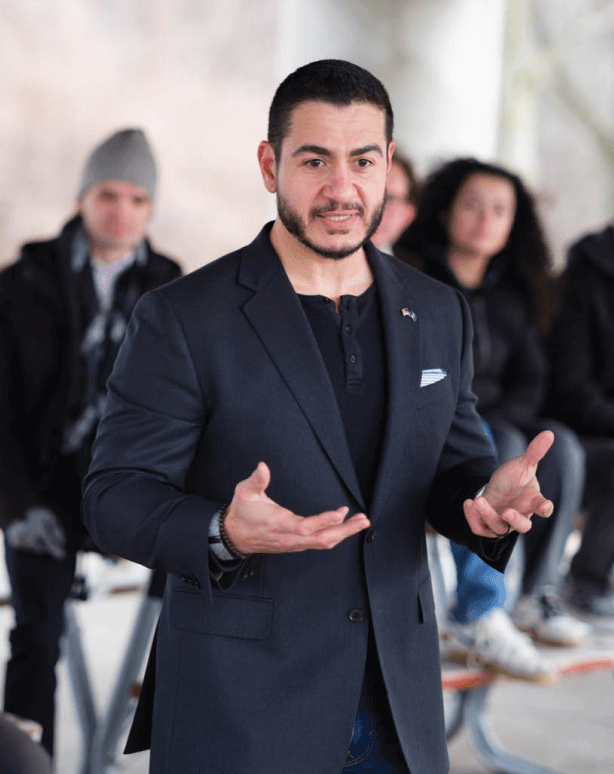
Dr. Abdul El-Sayed doesn’t come across as one might expect of a Rhodes Scholar with a rock-star celebrity status. His approachable, down-to-earth demeanor is consistent in both one-on-one conversations and high-profile speeches to thousands.
His signature casual look (a black V-neck shirt) isn’t a new gimmick — it’s been his wardrobe staple since childhood. This ability to balance the dual personas of academic and everyman has led to legions of diehard supporters and more than a few skeptics.
Most headlines have focused on Abdul’s economic and health care policy (and for good reason with those issues at the top of most voters’ minds) but I sat down with him to dig in on his less talked about stance on education and labor issues.
You’re a highly educated person; what does public education mean to you?
It’s the foundation of the life I got to build. You know, I went to public schools all the way through college, and it was teachers, like my fifth-grade teacher Ms. Smith, who invested in me and saw something in me, who showed me what I could be, and really took time to mentor and uplift.
Public educators are the greatest manifestation of public service, right? People who come to work every day to invest in our collective future, our kids, whose very future depends on what you do and what you give them. You can give part of yourself to somebody to empower everybody, and that’s a beautiful thing.
You mentioned Ms. Smith, your fifth-grade teacher. Take me back to 10 or 11-year-old Abdul, what kind of impact did Ms. Smith have on you?
Look, I was always good at school but didn’t always apply myself. This was a teacher who saw something in me and was willing to see beyond my penchant to get in trouble.
She was very honest with me, even at a young age, about the discipline it takes to be able to invest in yourself. I always appreciated that. She’s someone who was just a really gifted educator and, like all great teachers, they see something in you that you’re not willing to see or care for in yourself.
I can’t believe I have to ask this, but given today’s political climate, I do… should the Department of Education exist?
Yes (laughs), it should — because what are we doing if we can’t educate our kids?
I actually want to tie the Department of Education funding to the Department of Defense budget. Tie any percentage increase in defense spending to an equal increase in education funding and raise revenue by taxing capital gains and inheritances over $1 million as ordinary income, closing the stepped-up basis loophole, and enact a billionaire tax on wealth over $1 billion – so Wall Street and the ultra-wealthy, not our schools, foot the bill.
So, if you want to spend money on war, you’re going to spend money on education too.
Speaking of federal education initiatives, how do you feel about vouchers?
I believe public schools should stay public – it’s one of the great guarantees that we give to every child that they should have the right to a great public education. When people want to privatize that, that becomes a real risk, and we’ve seen what the consequences of privatizing public service looks like. It benefits the richest people, and the people who truly need support tend to be the ones who pay the price.
Shifting gears a bit – what does organized labor mean to you? What does it mean for Michigan?
Unions built this country. They built the state. They built the middle class. They built the 40-hour work week. They built the fact that our kids go to school instead of going to work. They built the weekend, and there is no coincidence that we are at an all-time low in union participation, all-time high in inequality.
If we’re serious about rebuilding the middle class, we have to be serious about empowering labor organizing in every sector of our lives, and I say this as a second-generation union member. My father was the president of an educators’ union, I’ve been a member of an educators’ union, and I know what unions can mean.
We have to double down on protecting union organizing and empowering unions to fight for our most vulnerable, whether they’re workers or our kids in public schools.
I know you have some very specific policy ideas, but overall, what kind of future do you want to see for public education?
The most sacred thing humans can do is communicate with each other and build community, and educators are the heart and soul of that. It’s not just about teaching information; it’s about creating the space within somebody to build themselves and become the future of our society.
Educators do that every day, and this is hallowed work, and it’s past time for us to dignify that work — not just by investing in minimum wages and tenure, but also investing in the people around teachers, like paraprofessionals and support staff.
We ask our teachers right now to be teachers and also custodians and social workers and nurses, because we’re disinvested in these other people who are so critical to empowering a student to be their best self.
Dignifying educators and students — that’s a real commitment that I have as a product of Michigan public schools.