
Oxford survivor becomes teacher, returns home – ‘I want to help people’
By Brenda Ortega
MEA Voice Editor
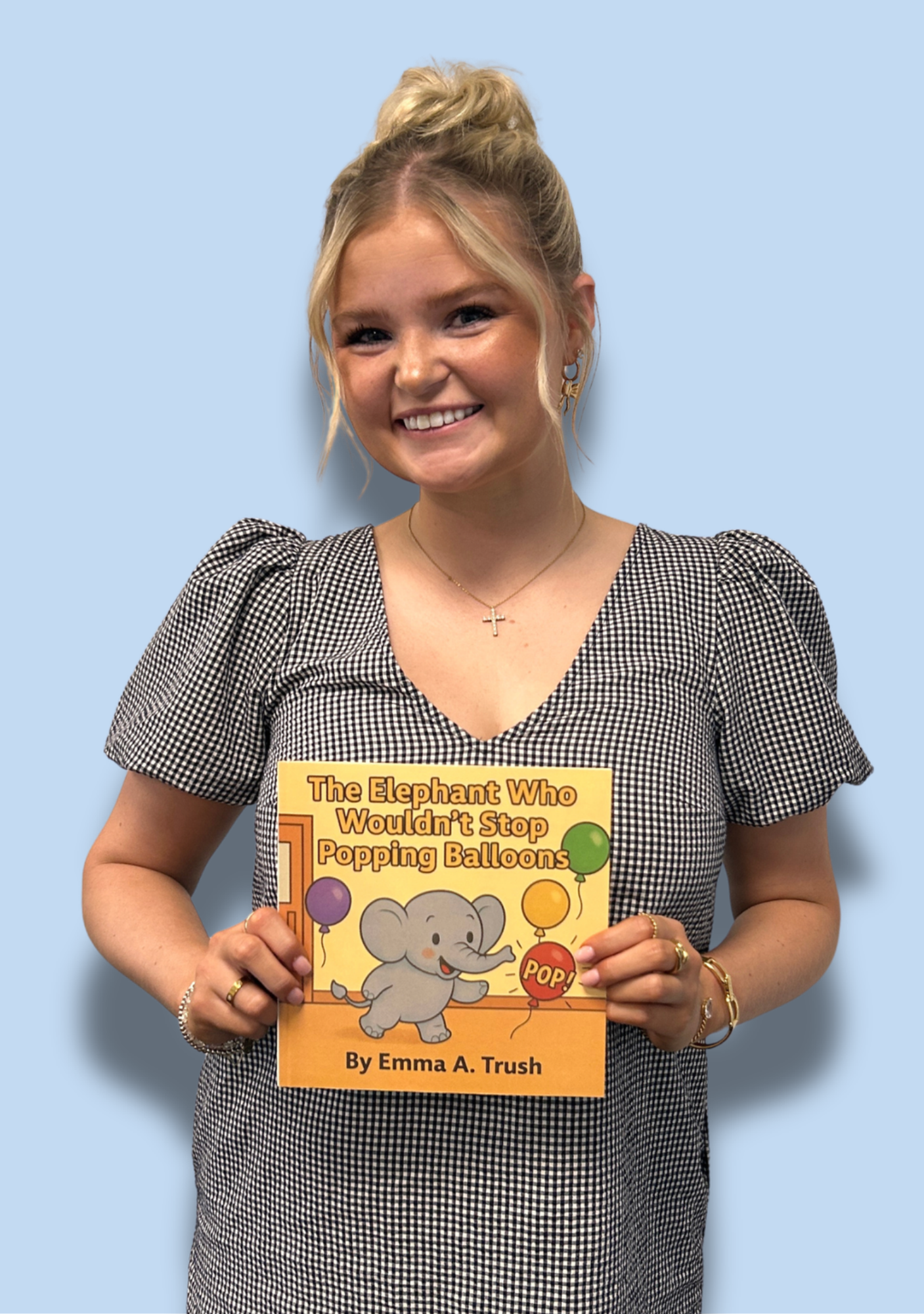
Five years ago, Emma Trush was a senior at Oxford High School when a student gunman opened fire in the building on Nov. 30, 2021, killing four classmates, injuring several others, and splitting her life into two parts: Before and After.
Before, Trush had been certain of her career plan to become a special education teacher, sparked by the joy of growing up with a younger sister who has moderate cognitive impairment and maximum zest for life.
After, she wasn’t sure she could go through with it. “Everything felt gray,” she says.
Before, she was in the process of choosing a college, having recently competed for a merit-based full-ride scholarship to Central Michigan University. After, she won the scholarship and chose CMU despite knowing, “My light was dimmed.”
Before, she didn’t believe a school shooting could happen in her tight-knit community. But after fleeing gunfire in the hallways of her high school on a bright Tuesday afternoon, she could no longer live inside the illusion of safety.
“It never happens to you — until it does.”
For a time in the aftermath of the tragedy, Trush feared it would negatively define her life forever. Struggling with symptoms of post-traumatic stress disorder (PTSD), she couldn’t imagine returning to Oxford after graduating the following June.
Today, however, Trush is a first-year special education teacher in the district. She fought her way back to a profession she loves, won a prestigious CMU award for an undergraduate capstone project promoting student safety, and graduated from college with honors.
Trush shares her remarkable journey to remind the world how survivors are left to handle complex, life-altering effects long after a school shooting fades from headlines or gets replaced by another one.
“There’s no blueprint to grief; there’s no blueprint to PTSD,” she said. “I am comfortable talking about it because I feel like sharing my story is only going to help others and it’s only going to help my future profession.”
Before, she had been a high-achieving, self-motivated student. Five years after, she is a promising new educator and MEA member whose courage and determination in the face of overwhelming trauma and grief offer a profound message of hope.
“I can’t let this stop me. I am a people helper. To the day I die, I want to help people.”
TRUSH CREDITS many helpers with supporting her in the heavy task of moving forward and trying to heal from the terrible events of that day: family, friends, teachers, the Oxford community — and eventually college roommates, classmates and professors.
Her sister with special needs, Bella, was 10 at the time and became Trush’s comfort — because “the one thing that I could count on being how it always has been my entire life was my sister.”
Bella still wanted to sing and dance and play Mario Kart, providing “escape,” Trush said. “Even though everyone else’s innocence was ripped away from us, she’s still here and she’s still bright and she’s overcome so many things that she was just that light in my life.”
Seeing her little sister’s experiences in special education had introduced Trush to “amazing” educators and programs in Oxford and Oakland County and ignited her passion for becoming a teacher.
At the time of the shootings, “Bella was in fifth grade, and her teacher was really close with my family because she had taught her for five years. I remember that day, her teacher told Bella, ‘Go give your sisters a hug when you get home.’”
Growing up in Oxford, Trush took for granted the closeness of people, the small-town atmosphere, the lifelong friendships that started in preschool dance classes.
“We were known as a farm town,” she said. “One thing I loved about my grade was we knew everyone’s name. We were all friends. I felt safe at school.”
Her sense of safety shattered in an instant. Just after lunch on the Tuesday after Thanksgiving.
THAT DAY she veered from her normal routine. A gut feeling led Trush to skip the long post-lunch route she usually walked with friends — deep into the hallway where the shooter would begin his rampage — and instead review notes for a quiz.
She was walking to class when she heard loud bangs she first thought might be lockers slamming shut. Still moving toward the sound, she saw students running in her direction.
“I’m kind of just frozen in time like, What is going on? Because it was just screams and nobody was saying anything. And then I see one of our family friends, who was a freshman at the time and just looks at me and says, ‘Emma, you need to run!’
“In that moment, I immediately turned around and started running out. That’s when the word ‘shooter’ was being screamed, and the pieces started to kind of flow together in my mind that this might be real.”
Outside, she made a brief and emotional call to her mom, jumped in a car with friends as numerous police and tactical vehicles arrived on scene, and realized her other sister — 18 months younger, “my best friend” — remained in the building.
Trush texted in all-caps, “SCHOOL SHOOTER” and her sister replied, from a classroom on the opposite side of the building, “What is going on?”
“I’m hysterically crying, and I’m trying to call her, and I know that wasn’t smart because you’re supposed to be quiet, and she’s barricaded inside the door. So she texted me back, and she texted my mom, and she’s like, “There’s guns outside the door. There’s guns everywhere.”
Their dad left work to find them; her sister was released; and Trush’s family reunited, collapsing in each other’s arms. Later she would learn of four classmates who died, including a friend, Justin Shilling, 17; Madisyn Baldwin, 17; Tate Myre, 16; and Hana St. Juliana, 14.
“I remember everything photographically, but driving away from the school and seeing all the ambulances and cops and SWAT cars, that is my huge PTS trigger to this day. I hate cop lights. I hate sirens. It’s just that identification I have with them to a horrible event.”
FOR MONTHS, life became a series of monumental challenges. Attending funerals. Restarting classes at the middle school. Returning to the high school. Graduating with classmates missing. Leaving home.
Learning didn’t return to normal that school year. Rigorous academic demands took a back seat to caring for people’s mental health and emotional needs. The start of college shocked her system, Trush said.
She no longer felt understood by those around her; she felt isolated. The first day of college classes amplified her tension when Trush gave her name and hometown during self-introductions, and the instructor replied, “Oh, so you were at the school shooting?”
“That shook me to my core,” Trush said. “I remember going home after the first class being like, ‘I can’t do this. I am not meant to be here. That’s all I’m going to be known as.’”
For the first year, she was too afraid to use a public restroom on campus, which was the location at the high school where the violence began and her friend Justin was killed. She didn’t know if she could be a teacher, or work in a school, though she didn’t change her major.
Trush hadn’t yet bonded with her roommate or dormmates, all of whom she now describes as “my ride-or-dies. I roomed with them all four years.”
Her roommate, Lily, became a close confidant. “She was the first person I truly opened up to. And her support was just… speechless. She knew exactly what to do; she just needed to listen… If I didn’t meet her, I don’t think I ever would’ve felt at home.”
By the time Nov. 30, 2022, came around, Trush’s new friends witnessed her raw pain.
“I stayed at school because I thought I could,” Trush said, “and I regretted that decision pretty immediately. I was struggling very hard that day of the one-year anniversary, being at school and not being at home near family and near people who went through it, too.”
Her friends submitted a referral to the university’s mental health service, CMU Cares, and Trush gratefully used the chance to talk that day — and every year after — becoming a strong advocate of the free program. But she was disappointed not to hear more from college officials.
“I think I just wanted something personal from the university saying, ‘Hey, we hear you and we see you. We support you. We’re here for you. If you need anything, please let us know.’”
Weeks later, on Feb. 13, 2023, shootings at Michigan State University killed three students, injured five more, and retraumatized Oxford survivors, some of whom were on campus and again found themselves hiding from an active shooter as college freshmen.
The stressors prompted Trush to act ahead of the second anniversary. She met with officials in the CMU president’s office to press for direct outreach to any students from Oxford.
“We had a really good conversation,” Trush said. “From that point on, we were in touch through my last couple of years at Central because they took it very well.”
HEALING has not happened in linear progression. However, sophomore year marked significant changes for the better.
With a trusted friend group and most general degree requirements completed, Trush began classes in her major with a cohort of aspiring educators who would form cohesive relationships over the next three years.
She connected with faculty, including MEA member Brandi Ansley, who began her career in psychology and mental health care more than 25 years ago before transitioning to teaching and special education.
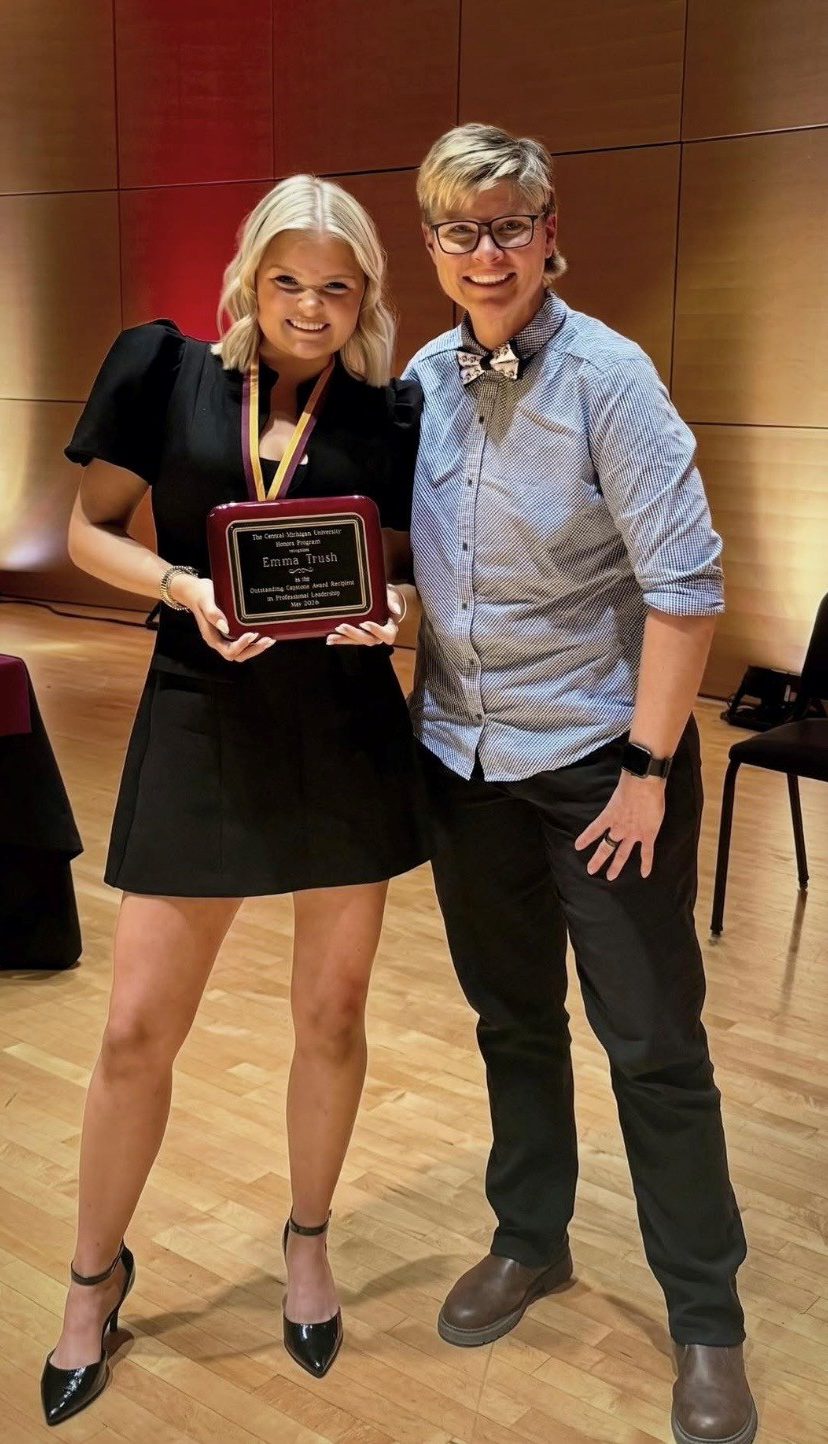
Ansley, who teaches courses in special education research and practice and facilitates the student teaching seminar, became a mentor and the professor who first allowed Trush to feel safe enough to show her true self in times of struggle.
“Having a professor that I was able to turn those (masking) parts off and be real and have support throughout everything, even when I wasn’t in courses, meant so, so much to me,” Trush said.
“I wouldn’t have been able to be the person I am today without Dr. Ansley, Dr. (Dawn) Decker, all the good people at Central that helped me find my passion again.”
As a student in the CMU Honors College, Trush was required to complete a senior capstone project. She mulled options as a sophomore: “What do I want to do? Something with school shootings. How can I help kids?”
She attended workshops and decided on a creative project. “I kept thinking, How can I help students in a way that is going to be inclusive to all? Because that’s my mind. That’s your mind in special education. You’re thinking about inclusion all the time.”
She latched on to the idea of a children’s book: a story-in-metaphor to prepare K-2 students and those with cognitive impairments to avoid danger they can’t fully comprehend.
In junior year, Trush had to get a proposal approved. An early submission was declined, but with the help of Ansley as her faculty advisor, she developed a winning plan that included a research component on children’s working and long-term memory to inform the book’s content.
The result is a “whimsical story” of an attention-seeking elephant popping balloons at school and a classroom of children blocking the door, turning off lights, hiding and staying quiet to get Ellie the elephant to go away.
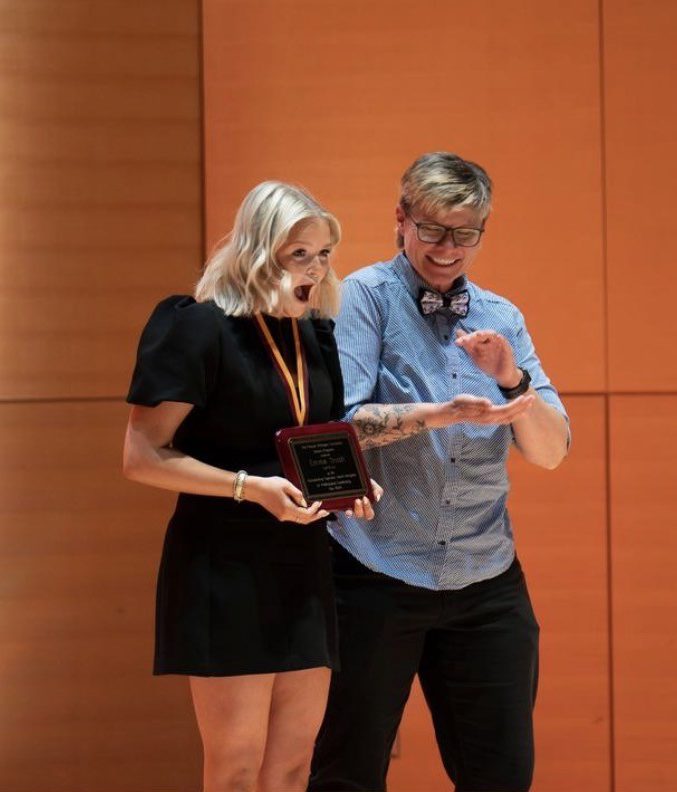
Another result: Trush’s creative/research project, “From Pages to Practice: School Shooting Safety Using Children’s Literature,” was selected by the CMU Honors Program for the Outstanding Capstone Award in Professional Leadership.
Trush says she was stunned by the recognition, having often felt like “an imposter” in the Honors College next to other high achieving students in science, engineering and math majors.
“Winning the award just solidified everything — like this is exactly where I was supposed to be.”
THE TEST came during student teaching in senior year. Trush got the chance to practice leading a classroom and try out her children’s story with students during her assignment in an elementary special education classroom in Mt. Pleasant Public Schools.
Titled The Elephant Who Wouldn’t Stop Popping Balloons, her book helps students best remember what to do if they act it out as the teacher reads and the story and motions are practiced weekly, Trush said.
“We did this as a hands-on experience that we were all doing together, going through the motions, moving around the room. I knew this, but they reminded me all the time — my kids loved movement. I miss them every single day… They really taught me how to be a teacher.”
A key philosophy of her teaching, developed through her life experiences and college training, is that inclusive environments are not just created but fostered. “I tell this to everyone I know,” she said.
“You can create an inclusive environment, but what are you doing every single day to make sure these students are comfortable, are safe with you, are growing as a student, growing as an individual?”
She also learned from her mentor, Dr. Ansley, to turn that focus on herself. Student wellbeing depends on educator wellbeing, and educators carry a heavy load, Trush said.
“I have learned significantly through college, through student teaching, how to separate myself from the classroom personally, to know the warning signs. When am I getting triggered? What can I do to take care of myself?
“Because I can’t protect everyone from everything. That’s a very hard truth. Having little sisters, I want to protect them from everything in the world, and I can’t.”
What also makes a difference is a supportive community, and Trush has that in spades. This summer, she accepted a job in Oxford Community Schools as a self-contained elementary special education teacher and says, “It feels really good to be home.
“All my previous teachers have reached out, gave me hugs at professional development days, and made this transition coming back to my home district wonderful. I’m so happy to be making a change in this district, as it has completely shaped me into the educator I am today!”
With all she’s accomplished in the past five years, Trush feels confident in her training, ability and resilience, she said.
“I am going to do great things no matter what I’ve been through. That doesn’t define me. I’m going to be a good educator. I’m going to make an impact on students. I’m going to provide them with a safe, inclusive environment.”
Read our package of stories, Oxford: Five Years After