Facts v Fallacy Part II: School Funding
By Brenda Ortega
MEA Voice Editor
 Michigan voters are likely to see the phrase “record school funding” in campaign mailers from both political parties this election year. The difference will be in perspective.
One side will use the term to tout recent gains in school funding as a point of pride in better supporting educators and students. The other side will use it as a weapon to attack schools for not achieving better test scores.
The truth is school funding saw much-needed increases over Gov. Gretchen Whitmer’s tenure. It’s accurate to say, in nominal dollars, the state achieved historic school funding.
But the claim of “record school funding” is misleading — not only because it fails to account for inflation, says MEA Labor Economist Tanner Delpier, a leading expert on school finance.
Typically used to compare Whitmer’s education record to her predecessor, Gov. Rick Snyder, the term “completely ignores the historical context before 2012, which is right around the time that school funding in the state hit rock bottom,” Delpier said.
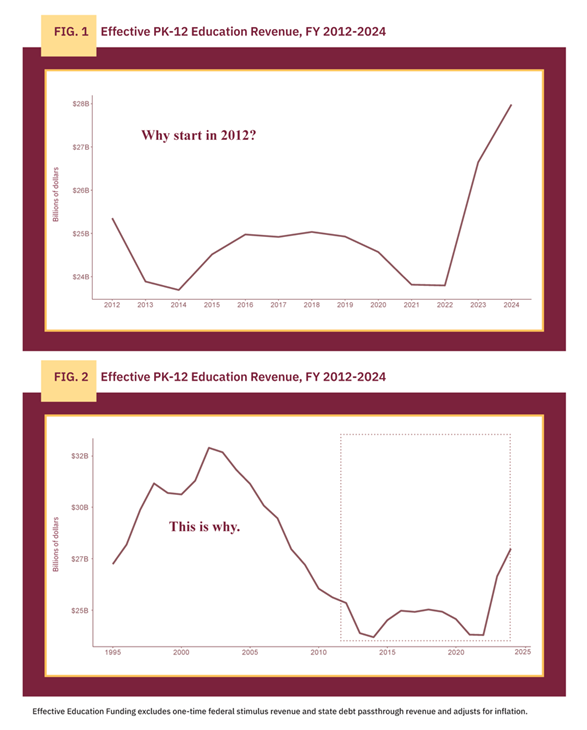
“Why start the line graph in 2012?” he asked. The answer is simple.
When compared to bottomed-out K-12 spending achieved by Snyder and a Republican-controlled state Legislature in 2014, significant increases led by Whitmer — especially in the past three years — appear as unprecedented. [Fig. 1]
Further pulling back the curtain from 2012 to 2002 reveals the true trendline, Delpier points out.
“There was a massive decline from 2002 to 2014, and earlier funding levels have not yet been restored. While the state is no longer at the lowest funding level in history, (school) funding remains 32% below that early 2000s peak — a gap amounting to about $10.4 billion.
“The truth is that funding has dropped sharply since Proposal A in 1994.” [Fig. 2]
LESS FUNDING ÷ MORE SCHOOLS
After Michigan voters approved Proposal A, amending the state constitution to shift school financing from local property taxes to state taxes, lawmakers increased spending on education for a few years. Then began the devastating decades-long decline.
Promoted by Gov. John Engler, a conservative proponent of market-based school reform centered on competition, Proposal A also ushered in charter schools and schools of choice which placed additional financial pressures on public school districts.
In effect, “The policy of Michigan has been to spread a declining share of state resources over an ever-increasing number of institutions while we have a declining student population,” Delpier said. “That is the definition of inefficiency.”
Michigan has the most for-profit charter schools in the nation. The state spends more than $1 billion on over 300 charter schools — 30% of which regularly fail and close due to low enrollment or financial mismanagement, according to a review by the Network for Public Education.
The rules in place allow charter school operators to generate profit from per-pupil revenue while holding land tax-free as it builds up value, Delpier said.
“The business model of charter schools is land speculation. When you have a school that is for-profit, in a literal sense what they have to do is what’s best for the shareholders rather than the students.”
In addition to unaccountable charter schools, a growing number of hidden costs drain dollars from K-12 districts.
One type is pension debt payments drawn from state education funds, which reduce what’s available to serve students. Other examples include underfunded state mandates and preschool expansion.
State policymakers also have accelerated a trend — as recently as the 2026 fiscal year budget — toward using the K-12 budget to pay for higher education, which historically came from the state’s general fund.
“Compared to the years after Proposal A, Michigan is now effectively transferring out $1.6 billion from K-12 schools to support community colleges and universities each year,” Delpier said. “In real terms, nearly $18 billion has been diverted away from K-12 schools since 2010.”
Recent per-pupil spending increases in 2023 and 2024 moved Michigan to the middle of the pack in national comparisons, he added. “While this recent increase in per-pupil funding may be ‘historic,’ the current funding level — in both per-pupil and total terms — is not.”
MONEY MATTERS
Numerous studies show that investing in schools and learning resources pays off in student outcomes, according to a research review by the Learning Policy Institute titled “How Money Matters in Schools.”
“The research documents that resource investments matter for student outcomes, especially when they are directed to under-resourced districts and students from low-income families,” the policy brief concludes.
The institute’s review found the biggest payoffs from investments toward smaller class sizes and additional supports for younger children and those with greater academic needs, plus ensuring educator quality through higher pay.
“Sustained improvements in the level and distribution of funding across local public school districts lead to improvements in the level and distribution of student outcomes, ranging from graduation rates to educational attainment and wages,” the report said.
“There is scarce evidence that one can gain stronger outcomes without these resources.”
The key word is “sustained,” Delpier said. “What the research literature tells us is that funding has to be sustained for a period of years before you expect to see impacts on achievement.”
A recent study by Michigan State University’s Education Policy Innovation Collaborative (EPIC) concurred with Delpier’s assessment that the state’s K-12 school funding has not rebounded from the peak of 2002 even as pressures have intensified on school districts.
Key findings from the EPIC study, titled “Funding Michigan’s Future: Three Decades of School Finance and the Policy Questions Ahead”:
- The demographics of Michigan’s student body have changed in ways that make it more expensive to provide education now than in the past. Today Michigan has fewer students and a student body with greater needs.
- Districts face greater restrictions on how they use their revenues now than in the past.
- Districts are now expected to provide more services beyond instruction (g. universal meals, student mental health), but funding for them has been unstable.
 Nevertheless, as election season intensifies, partisan pundits and politicians will turn up the volume on school funding and performance.
Critics of public education, including billionaire dark‑money donors like the DeVos family and the politicians and think tanks they finance, will talk about record funding and label schools as “failing” to make the case for further test-and-punish policies and privatization.
They will continue to say Michigan ranks 44th in the country in fourth-grade reading scores on the Nation’s Report Card, even though the test makers warn against using the data to rank states because score differences are often tiny enough to fall within the standard measuring error.
The election messaging was already clearly on display last June at a House Education Committee hearing on education budget goals and needs, as Rep. Brad Paquette (R-Niles) engaged in a lengthy argument with state education officials.
“We’ve increased funding, yet results are still tracking downward,” Paquette said. “When does accountability come into play?”
Committee member Rep. Dylan Wegela (D-Garden City) set the record straight: “Record funding is only as good as saying we have record wages today. When you adjust for inflation, we are barely ahead of the year 2000. This has created a classroom size problem and a teacher shortage.”
The forces tearing down public education over the past 20 years pretend it’s possible to do more with less funding, but their real goal is privatization and profit-making, says Josh Cowen, an MSU professor of education policy and member of UTSF MSU (Union of Tenure System Faculty).

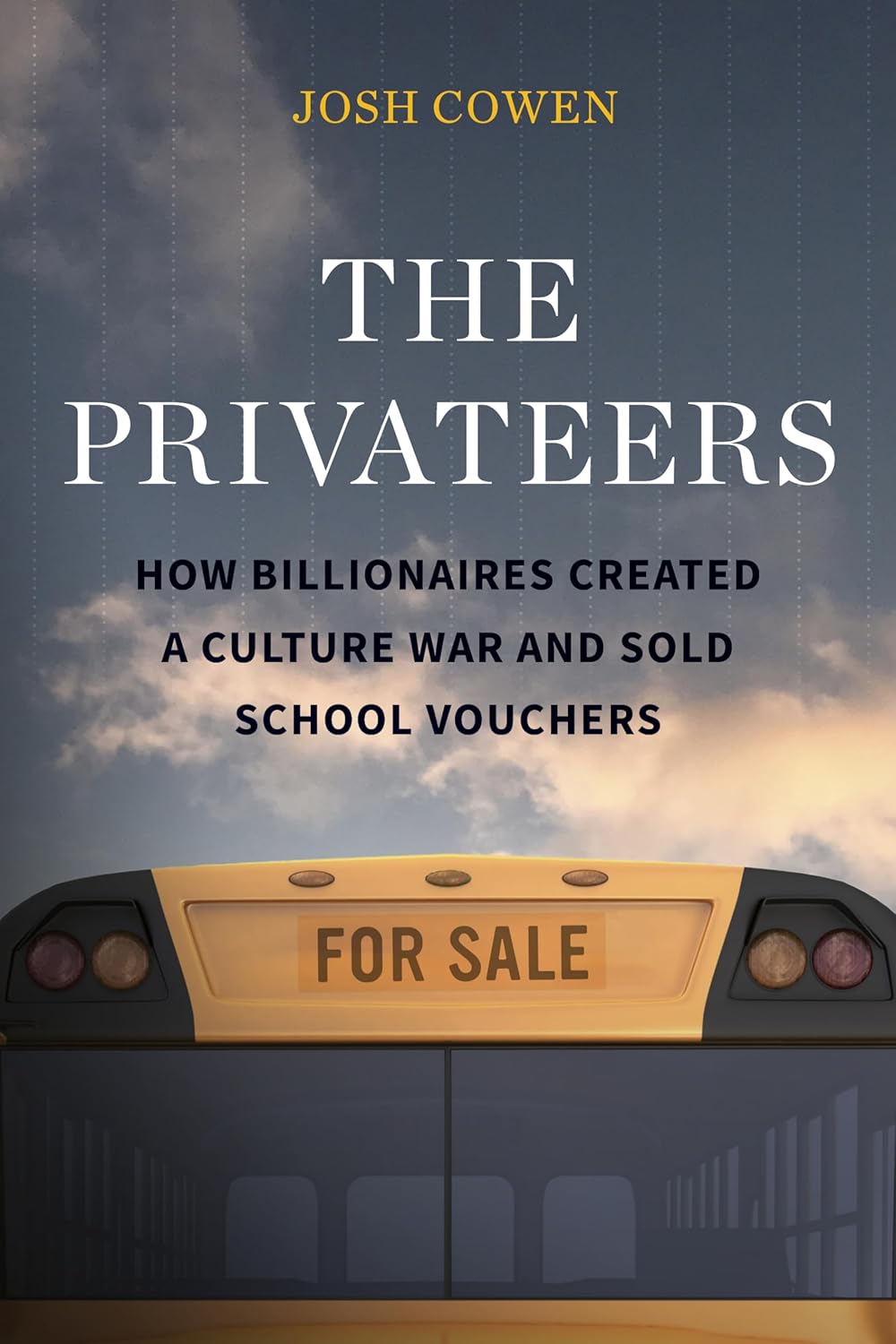
An expert on school vouchers and their effects on student performance, Cowen is the author of The Privateers: How Billionaires Created a Culture War and Sold School Vouchers.
What stands at 44th in the nation and falling is average starting teacher pay in Michigan, Cowen notes. Overall Michigan educators now earn nearly 23% less than other workers with similar levels of education and experience.
Cowen shared a new research paper in the February 2026 issue of Economics of Education Review, showing that increasing teacher pay in New Jersey led to large gains in student math and reading performance over time.
“No serious plan for improving Michigan schools exists without higher educator pay,” Cowen said.
Read more of Josh Cowen’s thoughts on this topic in the related story, “Data says vouchers harm kids.” Find related stories and source information from our three-part Facts v Fallacy series at mea.org/facts.