Candidates for governor spar at MEA forum
Candidates from across the political spectrum vying to be Michigan’s next governor have declared education to be a top priority in this critical election year. The differences emerge when they spell out what that means in terms of policies and proposals.
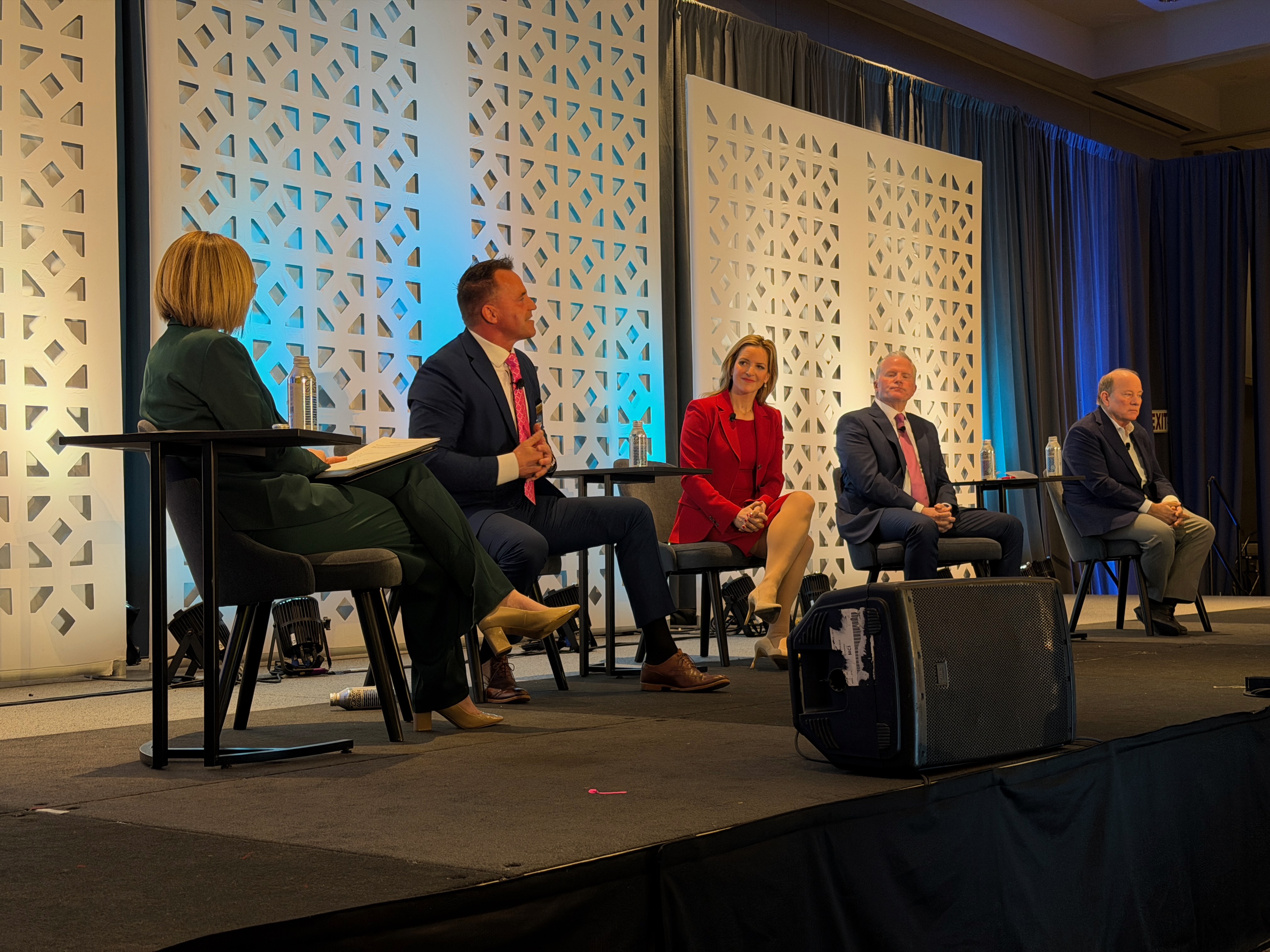
Educators got to hear details from four of those candidates at a live forum held during the MEA Winter Conference, including two Democrats, one Republican, and an independent running to succeed Gov. Gretchen Whitmer in November’s general election.
Watch the full conversation, livestreamed with Secretary of State Jocelyn Benson, former state Attorney General Mike Cox, Genesee County Sheriff Chris Swanson, and former Detroit Mayor Mike Duggan.
“It was really cool,” said JJ Lockwood, president of the Plymouth-Canton Education Association. “I brought some people with me (to the conference) this time that have never been to anything like this, so it’s really nice to see something like that go down live for them.”
A 20-year educator, Lockwood said in this critical election year he wants to hear detailed plans from candidates on how they will ensure adequate and stable school funding.
“There’s a lot of things we need to be able to do in schools to support kids, and we can’t do that when we don’t know what that funding source is going to look like from year to year to year,” Lockwood said.
Moderated by Michigan Public radio host Zoe Clark, the MEA event featured questions from members across the state. The first one selected by Clark came from Erinn Parker, an early career educator and union president in the Upper Peninsula’s Stephenson Area Schools.
“Education is the foundation of our nation. Education extends beyond partisan lines and is essential for ensuring a strong democracy. How will you prioritize education, students, and educators?”
Parker, who attended the forum, was glad to see candidates from different political parties fielding questions. She was especially interested in their positions on universal free school meals, because the program has been so successful in her high-need district.
When this school year began, and the state budget still hadn’t been passed, her district’s school board discussed whether to keep the program if the state cut funding, Parker said: “And our district decided it was in the best interest for our students… It is about helping our children.”
Three of the four candidates who appeared were largely introducing themselves to nearly 1,000 MEA members in attendance. For Benson, in her eighth year as secretary of state, the forum offered a chance to show new facets of her resume and experience.
First elected to statewide office alongside Whitmer in 2018, Benson told the crowd her parents were special education teachers and NEA members who inspired her to a career in public service and demonstrated how educators quietly show up early and stay late for students every day.
Benson vowed to fix a broken education funding system to beef up pay for educators and ensure stable resources for public schools.
“A significant reason why I am running for this office is because I know and have seen and have lived firsthand your struggles and the need to have a governor who has walked in your shoes and is on your side. That’s who I am; that’s who I’ve been my entire life.”
Swanson, sheriff of Genesee County since 2020, stressed his ties to organized labor and education along with his work in bringing the community together amid the Flint Water Crisis and creating a jail education program to help former inmates succeed after release.
A member of the American Federation of Teachers (AFT) and before that the state, county and municipal workers union, AFSCME, Swanson has taught classes in public health at University of Michigan-Flint.
Education is key, he said, “because when that breaks down, you have people that don’t pour into the economy. You have people that make bad decisions that make our communities unsafe. You have people that get into addictions. You have people that have a breakdown of their family.”
The only Republican to appear, Cox said he understands the role of public schools as the son of immigrants — a carpenter and a maid — and himself a former U.S. Marine and Oakland County prosecutor. He was a two-term Michigan attorney general from 2003-2011.
Cox focused his remarks on increasing school accountability, expanding school choice — including vouchers — and returning to letter grades to label schools’ performance based on test scores and other data.
Cox said he would give educators a place at the table where policy decisions are made but added: “I will let you know that parents and families and children will be at the head of that table.”
Duggan, the former Detroit mayor and Detroit Medical Center CEO now running as an independent candidate, touted his record of restoring fiscal stability to the hospital and the city by uniting factions.
Duggan described the current state of politics in Lansing as “toxic” and said he would heal divisions and return $1.3 billion diverted away from the school aid fund over the years.
“The money should be in the hands of our schools, and I’m somebody who’s going to do what I’m going to say. It’s not Republican or Democrat. We’re going to put the money back into the K-12 system.”
The second question selected by Clark, from MEA member Erika Darling of East Lansing schools, probed how the candidates would improve Michigan’s ranking of 44th in the nation for starting teacher pay — and also retain more experienced educators.
Benson, the youngest woman to lead an accredited law school in the U.S. as dean of Wayne State University’s law school from 2012-16, wants to see starting pay of $60,000 for teachers, plus additional and equitable funding for services and salaries to support and retain educators.
“The fact that we have defunded our schools at a higher rate than any other state for three decades now and the small amount of work that Democrats have done recently to restore some of that funding is far from what’s needed to actually get to where we need to be to have the excellent schools we want,” Benson said.
Cox, who said he did not expect to receive an MEA recommendation in his gubernatorial bid, answered that 20-year educators in Michigan already earn $90,000 — a claim that drew audible reactions from the audience. Providing schools with more money is not the answer, he said.
“I have to tell you, when we’re 48th (sic) in fourth grade reading, it’s hard to tell the people of Michigan that you need more money… Accountability brings results. Results bring more money for teachers. It’s that simple. And as your governor, I will work to bring more accountability.”
Swanson stressed the importance of valuing educators and investing in public schools to give young people access to opportunity. Otherwise, he said, “You know what happens? I see them, as the sheriff.”
Swanson drew a burst of applause when he acknowledged, “There’s parapros in here making 14 bucks an hour; that’s not right. We need to bring you back to the front line as a profession and pay you as such. That’s what I’m going to do.”
Duggan repeated his pledge to stop shifting money away from the school aid fund: “I will restore that money over five years by reducing 2% a year in the general fund. I will put every dollar back in and leave it there permanently.”
A longtime Democrat and the second longest-serving mayor in Detroit history, Duggan painted Democrats and Republicans with the same brush. His candidacy has raised questions: Can an independent win? Will he act as a “spoiler” by drawing more of his votes from one side of the political aisle?
Duggan didn’t address those questions, but in response to another by MEA member Jessica Fiedorowicz — a South Haven teacher — he said, “Democrats and Republicans have switched your curriculums every couple years. They’ve switched your measurements every couple years.”
Fiedorowicz asked candidates to explain how they would ensure stable and equitable school funding. Duggan said he would restore the diverted money along with a statewide plan for improvement.
He touted his record of leading financial turnaround in Detroit and at the Detroit Medical Center, although his tenure at the formerly nonprofit medical system was marked by labor unrest, charges of union busting, and the system’s sale to a for-profit company.
“We are going to put that money in smaller class sizes,” he said. “We are going to put it into parapros helping, particularly in the early reading years. We are going to put it in libraries… I want to both put the money in and give you the kind of leadership that you can produce results with it.”
Cox said he wouldn’t “throw more money” at public schools until test scores improve. “But if we start to lead and manage and not dwell on the (money), and we start to get results for the parents and the families of Michigan, then parents and families will rally around,” he said.
Swanson committed to protect K-12 funding and switch to a two-year budget process for greater stability. When he first started teaching at UM-Flint 30 years ago, he said, many of his students were pursuing education degrees, but not anymore.
“There’s a void because there’s not an incentive — the state making it a priority. Healthcare and education are the top two budgets in this $81 billion budget. It’s not a political talking point. It is, as I said from my first comment, the baseline of our state and our economy.”
Benson noted recent studies that have shown Michigan led the nation in cuts to education funding over the past 25 years — with a decline of 30% from 2002 to 2015, according to education policy researchers at Michigan State University.
She advocates getting rid of the state’s “one size fits all” funding model for a more equitable system and building wraparound services to improve the well-being of children and families. Benson said she would separate K-12 and higher education funding but ensure support for both.
“Both are critical to enabling our education community, all of you, to prepare our young people for the jobs of tomorrow. But we have to change the structure of how we’re funding education in the state if we’re going to get to that goal we all have — which is for our schools to be the best in the nation.”

All four candidates fleshed out their positions in response to other MEA members’ questions — on funding for mental health positions in schools, immigration enforcement, universal free school meals, and more.
The 90-minute forum concluded with a question from MEA member Eric Henzi, a teacher in Wayne-Westland, who asked how the candidates would return Michigan to its status as a top 10 state in the nation for education as it was three decades ago.
Henzi shared a photo of his reaction, snapped by a colleague at the moment his question was asked by the moderator, and said it “meant a lot” to listen to responses. Overall, Henzi liked what he heard from Benson and urged other educators to ask questions, get informed, and vote.
“It’s really important that education issues are discussed by the candidates, because as educators we know this is how we help to create a better state,” he said. “Our students are going to be productive members of society. They are the future, and this is where it begins.”